



Recovery after rhinoplasty is gradual, and the most useful thing a patient can have is a clear picture of the sequence rather than a countdown.
Healing rates vary between individuals, so treat these as stages to recognise rather than dates to match.
The first days
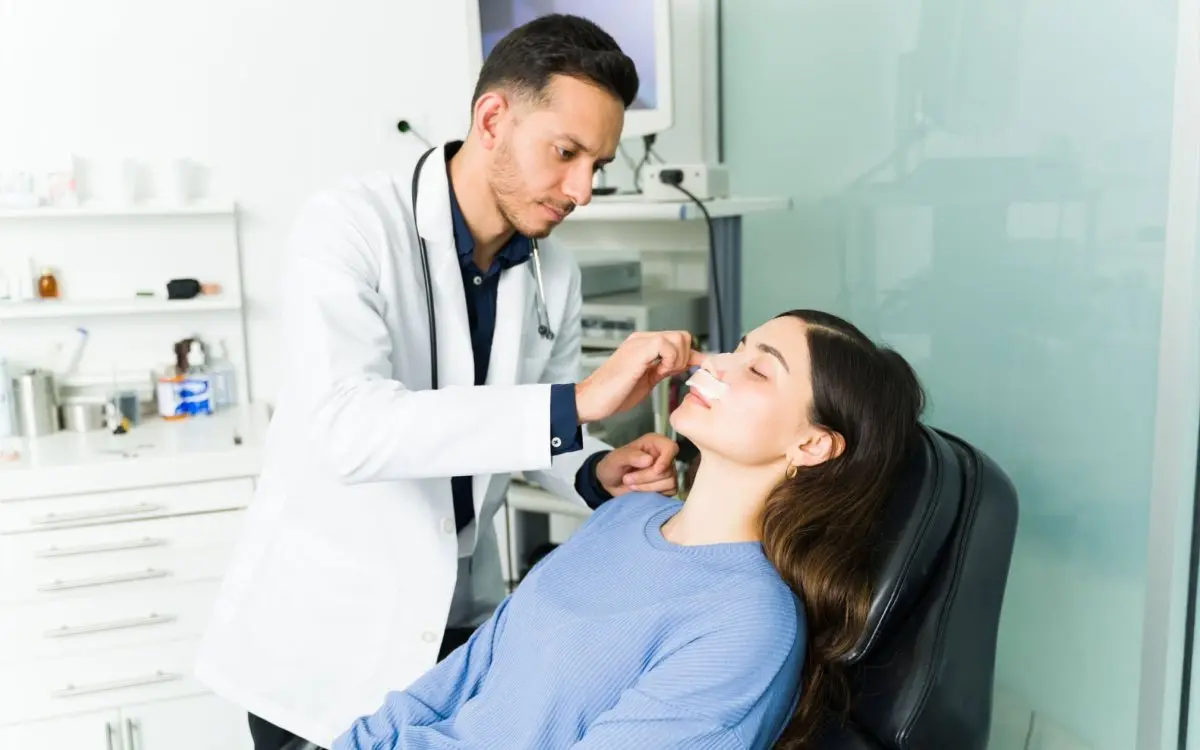
Expect nasal blockage, swelling around the eyes in some cases, and a sensation of pressure rather than sharp pain. External support is usually in place, and you will be advised to sleep with your head raised and to avoid bending or straining.
Cool compresses, prescribed medication and rest form the routine. Most patients are surprised by how manageable the first days feel compared with their expectations.
The early weeks
- External support is removed, and the nose looks swollen and wider than you pictured at first.
- Bruising fades around the eyes, and congestion improves gradually.
- Return to light activity is encouraged, while strenuous exercise and contact sport wait.
- Glasses and sun exposure need protection during this period, as instructed.
- Sleeping position stays slightly raised for a while to limit swelling.
The settling months
Swelling reduces unevenly, and it is common for one side to settle before the other. The tip is often the last area to refine, which is why early judgements about definition are premature.
Sensation may feel altered for a period, and the nose can feel stiff or numb. These changes usually improve as healing continues.
The final shape is judged once the healing process has largely completed, well beyond the first weeks.
Practicalities for patients who travel
Flying home is planned around your review and your surgeon assessment, and airline requirements are considered. Long journeys call for movement, hydration and simple measures to reduce clot risk.
Photographs are useful during remote reviews, and we explain how to take them consistently in natural light so changes can be compared fairly.
When we advise against this procedure
We advise against rhinoplasty, or advise waiting, when your schedule leaves no room for the recovery stages, when you cannot avoid strenuous work or contact sport during early healing, when you would be travelling home alone too soon, or when a significant untreated health condition makes anaesthesia unwise.
We also decline when a patient says they cannot tolerate any visible swelling for a period. That expectation cannot be met by surgery.
Frequently asked questions
When can I go back to work?
It depends on your job and on how you heal. Many patients return to non-physical work once early swelling has settled, and we advise individually.
When can I exercise again?
Light activity comes first, then gradually more. Strenuous training and contact sport are reintroduced later, on your surgeon instructions.
How long does swelling last?
Swelling reduces over a long period, and the tip refines last. Judging the final result early usually leads to unnecessary worry.
When can I wear glasses?
Typically after a period of protection, and often with the frames supported away from the bridge. You receive specific instructions.
When can I fly home?
Once your surgeon confirms that healing and your review allow it. We plan this with you rather than against a fixed date.
Is numbness normal?
Altered sensation around the nose and upper lip is common after surgery and usually improves as healing progresses.
Most questions arise in the first weeks, when swelling changes quickly. You will have a direct contact route and clear guidance about which symptoms justify urgent local attention rather than waiting for the next scheduled review. Contacting us early is never treated as an inconvenience.
How we approach this at Jelan Clinic
At Jelan Clinic you receive a written recovery guide before surgery, describing each stage, what to avoid and which symptoms need attention. Reviews are scheduled around the stages rather than around convenience.
After you return home, remote reviews continue with photographs and direct contact, so small concerns are addressed early rather than left until a future trip.
If you are unsure whether your healing is on track, ask. Photographs plus a short description of what you feel are usually enough for us to tell whether a change is expected or needs attention, and that question is always welcome, however small it seems.
Next step
Send your photographs and tell us about your work, your sport and your travel plans. We will explain how your recovery would be organised and answer your questions before you commit to anything.
What we tell patients before they travel home
Before departure you receive a written summary of where you are in the healing sequence, what is expected next, which symptoms need urgent attention and when the next review will take place.
You also receive realistic descriptions of appearance at each stage, including the parts patients find hardest, such as swelling that shifts from side to side. Knowing in advance that this is normal prevents a great deal of worry later.
Preparing well is not complicated. Gather your health information, your medication list and any previous operative notes, write down your questions, and give yourself time to consider the answers.
We would rather answer a difficult question early than discover it after surgery, and we would rather tell you that a procedure is not right for you than accept a plan we cannot stand behind.
This article is educational information only. It does not diagnose, does not recommend a treatment for you, and does not promise any outcome.
A prior medical consultation is mandatory; the final decision rests with our specialised medical team after assessment.
Would you like to know what can be achieved in your case?
Send your name and WhatsApp number — we review your case with our specialised medical team and send a written plan: what can be achieved and what the programme includes. No commitment.
Medical details are determined after assessment by our specialised medical team; the final decision rests with them.
Are you a suitable candidate?
This information is educational only, and every patient is different. Send us your photo and details, and we will review them with the doctor to clarify: whether the procedure is suitable, what can be achieved, and the next step.
Prior medical consultation is required; the final decision rests with the doctor after assessment.